



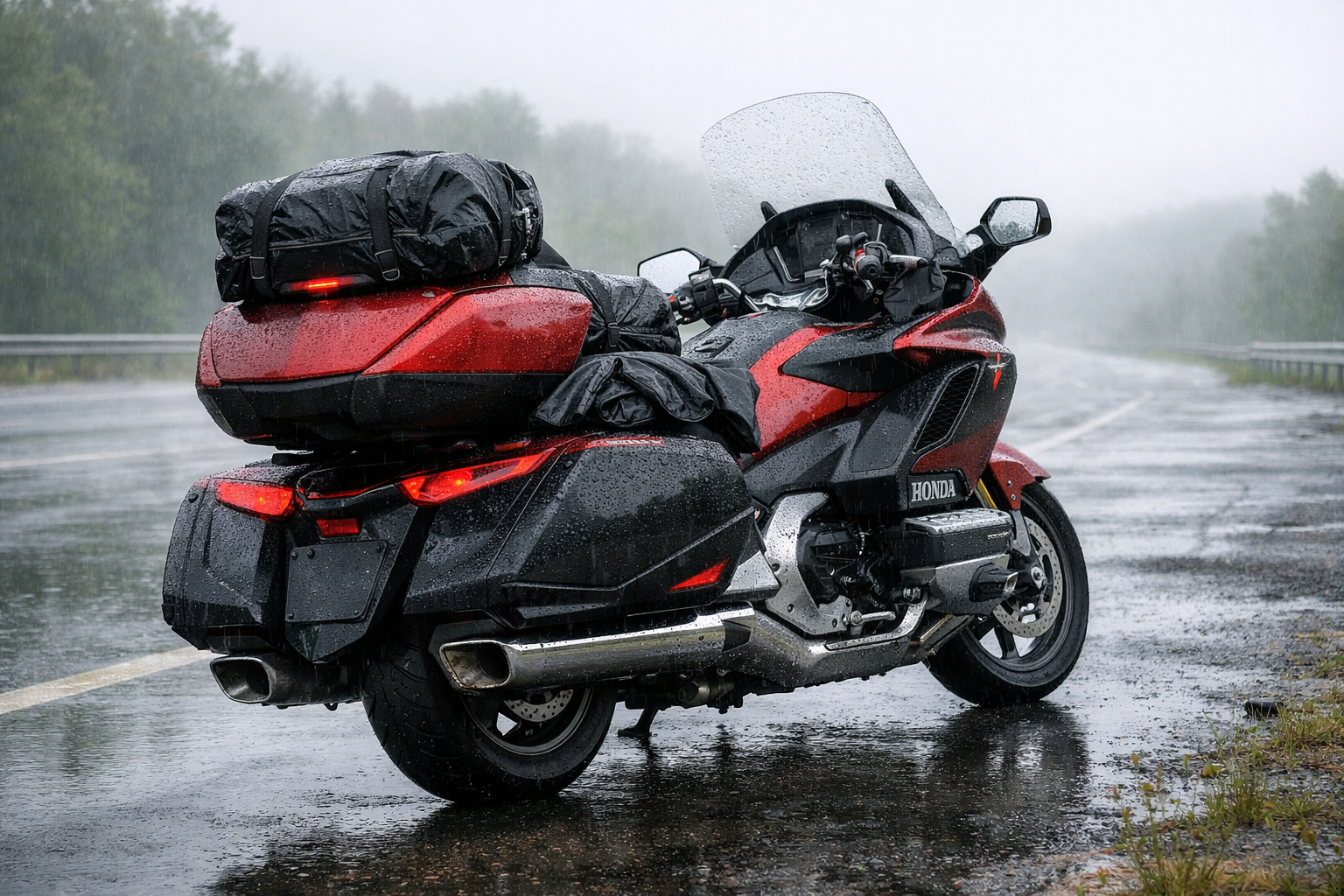
One of those moments is the feeling that a Goldwing is effortless to tour around in over a day, until the weather changes. I will never forget a ride of many miles when the forecast was truly light showers, but it was hours of constant rain, truck spray and that mist that seeps into zips and seams. When I finally got to the hotel my gloves were wet, another pair was wet, and the so-called waterproof bag that I had been relying on had silently abandoned me.
This is the reason why packing smartly and Goldwing luggage and rain covers are so important on actual trips.
Why Goldwing touring dips your luggage in more water than you may imagine
Even when it is ugly up in the air, a Goldwing is so comfortable and stable as to entice you to continue. Still road spray is not much better than rain. Your front wheel throws water upwards, cross winds push on it sideways and traffic blasts water backwards. Though your baggage may be placed behind fairings and panels, it will still be under the pressure of the moisture that can rush in even into the tiny spaces.
The other issue is time. Three or six hours under wet conditions may not strain your equipment, but certainly will test every coils of zippers, sewing stitch and closure pattern. Weatherproofing is not a survival in a drizzle but an increased risk reduction over a long exposure.
Know how your long trip will be in your luggage at Goldwing.
Storage capacity is usually inbuilt on goldwings, however, most riders upgrade to accommodate touring over a day. All the forms of luggage approach wet weather in a different way.
Goldwing luggage types and how they handle wet weather
Hard cases and factory storage: powerful structure, weak points in the shadows
Top boxes and hard panniers provide a great protection against the direct hits and consistent shape. A weak joint is typically the seal. Lid gasket compression, latches being a little looser and dirt forming micro-gaps that allow entry of moisture during heavy spray are all things which occur over time.
Hard Cases make a great foundation, but they enjoy the ease of easy customs, such as sealing the shops before you roll out, and verifying that the firm was firmly closed.
Soft luggage systems: bendable and spacious, yet dampness is an option
The reason behind the popularity of the soft bags is on the fact that it is an expanding and compressing material that fits odd spaces. The trick is that fabric is capable of being wet-out, that is to say the surface layer becomes saturated and passes moisture in under pressure, seams or zippers.
An outer appearance of a bag might look good yet it can permit moisture to accumulate inside. In the case of soft luggage, the most effective plan would be to assume that the outer bag can be wet and pack the items in a bag separately.
Rack bags and tail packs: the most open location
Any object on a back rack is in the slipstream and surprises with the amount of spray. The tail pack is convenient, however serious waterproofing is involved since the pack is always hit by the rear in rain and by the water thrown behind by the rear wheel.
Rain covers vs internal dry protection
What truly works better with rain covers or internal dry protection
The majority of riders argue on the use of external rain covers or internal dry bags. As a matter of fact, the best strategy is typically a layered system.
Raincovers: quick defense, although it depends on fit and tension
Rain covers are effective when they are not loose and are not flapping. Water can be funnelled by loose cloth, and abrasiveness of the cover can be achieved by constant movement.
Find bag covers that match your shape, and have an elasticized edge and strap anchors to hold the tension constant at highway speed. A tailored cover will also lessen the wind resistance and will not allow your luggage to get dirty with road dirt.
Internal dry bags: the second wall that is reliable
The choice I feel safe in making when it is clear that the ride simply cannot handle wet gear is to use internal dry bags. Panniers or soft bags with roll-top dry sacks offer a secure point of closure should the exterior luggage be wet.
This is particularly useful in clothes, electronic items, papers and whatever you want to be warm and dry at the end of the day.
The ideal touring system: weatherproof on the outside, waterproof on the inside
Rain is something I accept on Goldwing multi-day trips. The practical winner is carrying the bag with a rain cover but having important items in dry sacks. In that manner, the cover will take care of the majority of water exposure and the dry sack will take care of the leakage, condensation, or bugs in the zipper.
What to consider in truly weather-ready rain covers
Not all rain covers are equal. These little design features are important when you will be riding long hours in the actual rain.
Construction of seam and edge design
Water seeks opportunities in the seams. Covers having smoothly finished edges and high edge elasticity resist pooling and slow seepage. The edge needs to be folded under the bag and then the cover is not going to ride up at speed.
Flapping stops by means of attaching
The loose cover is made into a sail by highway wind. The cover is locked in place by secure points, which minimize noise and wear. A stable cover will also keep your luggage cleaner, as well, which is important when you are on a trip, and do not want to unpack dirty equipment at every single stop.
Heat and exhaust awareness
There is heating of the goldwings, and the position of some luggage is near hot panels or exhaust outlet. A cover must be able to withstand hot temperatures, and it should not melt or deform at the points of contact with hot items. The damage caused by long days is also avoided by proper routing and clearance.
Packing habits that keep gear waterproof in heavy rain
It helps to wear weatherproof attire, technique renders it reliable.
Store dry stuff in a special dry bag, and then you are never putting on the roll of dice with that stuff. Roll it up, a roll-top that is in a hurry is one of the most frequent places of failure.
Different wet and dry layers to avoid transfer of moisture within your luggage. In case you pause and it is raining, do not leave your bags open too long, because the water tends to drip more than you can imagine.
One little thing but a mighty one is to perform a quick water check before taking off: to ensure the lids are completely in place, the zippers are completely closed and the straps are pulled tight. Bad equipment is nothing compared to wet clothes due to a half-zipped zipper.
Conclusion: construct a weatherproofing system that you will be confident in
It is not about purchasing a single item that will keep your gear dry on a multi-day Goldwing adventure, but instead it is a system of smart luggage selection, sure weather protection, and a packing strategy that presupposes that the weather will challenge you.
A reliable external shield and a reliable internal waterproof storage combine to ensure that next time you are on the ride, you will avoid worrying about the rain and instead have fun on the ride once again.
In case you are upgrading your touring outfit, ShinyWing may be a part of this system-oriented strategy of covering the equipment that makes your travels comfortable.
FAQs
Will factory Goldwing panniers ensure nothing gets wet during heavy rain?
They work admirably in most situations, but if they are subjected to extended exposure to road spray, gasket wear or slight misalignment will be evident. When traveling on a tour over a couple of days then it is clever to keep valuable items in a dry sack.
Should we use rain covers when the luggage is soft and is going to be carried over long highways?
They may be, but only because the cover is secured firmly in place and is snug. To be totally sure, a rain cover and internal waterproof storage of valuables and spare clothes is the way to go.
How do you best keep the electronics safe when touring?
Store in a closed, dry, bag or waterproof sack in the middle of your luggage, and keep electronics away at the center of bag instead of near the edges where water usually enters.
Why cannot waterproof zippers be closed without any leakage?
Waterproof zipper decreases direct access, yet through force of pressure-induced spray, prolonged wear can cause water to penetrate between the teeth of the zipper, the stitching or at the ends of the zipper. The rain length is longer, the higher the chances of small seepage being noticed.
What can I do to keep off mildew on wet rides in several days?
Dry your baggage as often as you can even momentarily. Open bags at the hotel to be able to ventilate, wipe off moisture on surfaces, and separate damp layers. The simplest tool of preventing mildew is airflow.
